
Houston AC Repair Guide: When to Call, What to Ask, and How Not to Get Burned
Author
JaseBud
Date Published

Houston air conditioning is not a comfort system. From May through October it is a life-safety system, and the city's humidity destroys equipment faster than the heat alone. This guide is for homeowners trying to figure out whether to call for AC repair, what is likely wrong, what to ask a contractor before they pull the truck up, and when to push back on a quote. It is an editorial guide written for readers, not for any contractor — there is no sponsored list at the bottom.
If your AC has just stopped cooling and you are reading this on a 95-degree afternoon, skip to the 'Quick checks before you call' section near the end. If you have time to read the rest first, you will spend less and choose better.
Why Houston is uniquely hard on air conditioners
The textbook design conditions for a residential AC system are 95°F outdoor temperature and 75°F indoor. Houston runs above the design temperature for most of the summer, and the humidity routinely sits above 80 percent. The compressor cycles longer, the evaporator coil pulls more water out of the air, and the condenser dumps that heat into an outdoor environment that is already warm and wet. Every part of the cycle is working harder than the equipment was specified for. Older homes in The Heights and Montrose with original ductwork and undersized returns tend to wear systems out the fastest; newer suburbs in Katy, Sugar Land, and The Woodlands generally have better-sized systems but still see the same humidity-driven failures.
The most common consequences of that overwork in Houston homes are coil freeze-ups, capacitor failures, blower-motor burnout, and slow refrigerant loss through expansion-valve and fitting seals. Compressors — the most expensive component to replace — usually fail last, but they fail because of the cascading damage from those smaller problems left unfixed. If the unit is short-cycling or icing over and you ignore it, you are running up the bill for the eventual compressor replacement.
The five problems Houston HVAC contractors see most often
1. Frozen evaporator coil
Symptoms: air coming out of the vents is weak, slightly warm, or stopped entirely; a sheet of ice visible on the indoor coil or copper line near the furnace; water dripping or pooling. Causes, in roughly the order Houston technicians find them: dirty air filter restricting return airflow, low refrigerant from a slow leak, a failing blower motor that is no longer pushing enough air across the coil, or a clogged condensate drain backing up against the coil. The fix is almost never just to thaw the coil — that gets you running for the rest of the day, but the underlying cause needs to be identified or it will happen again within a week. A frozen coil that ignored long enough sends liquid refrigerant back to the compressor, which is the slug failure that destroys it.
2. Bad capacitor
Symptoms: outdoor unit hums but the fan doesn't spin, or starts and stops several times before catching, or the indoor blower won't start. Capacitors are roughly $20 to $40 parts and a 20-minute swap. They are also the single most common Houston AC failure because the high-heat afternoons cook them out. A fair price for a capacitor replacement in this market is $150 to $300 including diagnostic and labor. If a contractor quotes you $700 to replace a single capacitor, get a second opinion before you sign.
3. Low refrigerant
Symptoms: long run times, weak cooling, ice on lines, higher electric bills. Systems are sealed and shouldn't lose refrigerant under normal use. A loss means a leak — most commonly at the evaporator coil, the suction-line schrader valve, or service-valve fittings on the outdoor unit. The honest answer from a good contractor is: we can add refrigerant today to get you cooling, but we need to find and fix the leak or we'll be back. Be wary of any service that adds refrigerant without leak-testing and quotes you a big number per pound. Houston market rates for R-410A refills run roughly $80 to $150 per pound; R-22 systems (pre-2010) are much more expensive because R-22 is being phased out.
4. Failing blower motor
Symptoms: weak airflow, strange humming, or no air at all from the registers. PSC and ECM blower motors are different parts at very different prices — PSC motors are simpler and run $300 to $500 installed; ECM (variable-speed) motors are more expensive at $600 to $1,200. A contractor who is fair will tell you which type your furnace has and quote accordingly.
5. Compressor failure
Symptoms: outdoor unit not cooling, breaker tripping, sometimes a burning smell. Compressor replacement on a residential split system runs $1,500 to $3,000 parts and labor; if the system is more than 10 years old and the compressor has failed, replacing the whole system is often the better economic call. Contractors will sometimes try hard to push a full-system replacement when the compressor itself could be replaced under warranty — ask explicitly whether the compressor is still under the manufacturer warranty (most run 10 years on parts) before agreeing.
Texas licensing: TDLR rules and how to verify a contractor
This is the single most important section of this guide. Anyone who installs, repairs, or services air conditioning or refrigeration equipment in Texas must hold a license from the Texas Department of Licensing and Regulation (TDLR). The two relevant license types are TACLA (Class A) for unlimited residential and commercial work, and TACLB (Class B) for residential and light-commercial systems under 25 tons of cooling. Companies must hold a license; individual technicians register separately.
Anyone who shows up at your house claiming to do AC work without a TDLR license is operating illegally, and you have essentially no recourse if they damage your equipment or your home. To check, ask for the company's TDLR license number and look it up on the TDLR website. The lookup is free and takes 30 seconds. Verify the license is active and that the business name on the license matches the business name on the truck and the quote. A legitimate Houston contractor will hand you the license number without hesitation.
Also confirm general liability insurance — this is required to maintain a TDLR license, and a contractor with current insurance will share a certificate without complaint. Workers' compensation insurance is not technically required in Texas but reputable larger companies carry it. If a contractor's technician falls off your roof and the contractor has no workers' comp, your homeowner's policy can become the next stop.
Red flags to walk away from
Patterns that mean you should get a second opinion or hang up and call someone else:
- Pressure to decide today on a system replacement, especially without a written quote.
- A quote dramatically higher than two others for the same work — Houston is competitive, prices should be within 10 to 20 percent of each other for the same scope.
- A diagnostic 'finds' multiple expensive problems on a system that was working a few months ago.
- A refusal to leave a written estimate behind, or any version of 'we don't do that in writing.'
- A refusal to itemize parts and labor — you should see specific part numbers and hours.
- A 'free' tune-up that converts into a $4,000 system-replacement quote.
- A demand for full payment upfront on a multi-thousand-dollar repair (deposits of 25 to 50 percent are normal for a system replacement; full prepayment is not).
- Any pitch that involves financing through a finance company you've never heard of with a same-day signature.
- A truck with no TDLR license number visible — Texas requires it on the vehicle.
Repair versus replace: the honest math
The rule most Houston HVAC pros use, and the one that holds up well in practice: if a single repair is more than 50 percent of the cost of replacement, replace; if the system is more than 12 years old and any repair is over $500, lean toward replacement; if the system is less than 8 years old, almost always repair. New residential systems in Houston run $7,000 to $15,000 installed for the standard 14 to 16 SEER range, and meaningfully more for high-efficiency variable-speed systems. The federal HVAC efficiency standard moved to 15 SEER2 in 2023, so new installs in Texas will be at least that efficient by code.
Whether efficiency upgrades pay back in Houston depends on your electric bill. A typical Houston home running an old 10 SEER system on a six-month summer cooling season can save $300 to $600 per year moving to a 16 SEER2 system — meaningful, but the payback on the price gap is 8 to 15 years on its own. Pair the upgrade with rebates from CenterPoint Energy and your utility (these change year to year, ask for them by name when quoting) and the math improves. Don't let a contractor sell you efficiency-only savings without showing you their math.
Quick checks before you call
Before you dial a contractor, run through these. It takes about ten minutes and resolves a surprising share of summer service calls.
- Check the air filter. If it has not been changed in three months, change it. A clogged filter starves the coil of airflow and is the most common cause of a frozen coil. Filters at any hardware store are $5 to $25.
- Check the thermostat. Cool mode, fan set to auto, batteries fresh.
- Check the breaker. Both the indoor (furnace/air handler) and outdoor (condenser) breakers should be on. If one tripped, reset it once. If it trips again immediately, do not reset it — that's an electrical fault that needs a pro.
- Look at the outdoor unit. The condenser fan on top should be spinning when the system is calling for cooling. If it isn't, check for debris (a piece of garden hose, a plastic bag) blocking it.
- Walk around the indoor furnace/air handler. A puddle on the floor usually means a clogged condensate drain. Some homeowners pour a cup of distilled vinegar into the drain access port quarterly to keep algae down — it works.
- Listen. A hum without a fan spin on the outdoor unit is usually the capacitor.
How to get three quotes and actually compare them
If the problem looks like a real repair or a system replacement, get three written quotes. Tell each contractor the exact same description of the problem — write it down and read it to them. Ask each for the same scope: diagnose, fix, document parts replaced. For replacement quotes, ask all three contractors to spec equivalent equipment: same tonnage, same SEER2 rating, same brand tier (Lennox, Trane, Carrier, Daikin, Goodman). It's the only way to compare apples to apples.
Houston has a lot of solid mid-sized HVAC firms that have been around for decades and a flood of newer, often less-experienced operators. The TDLR license check, three written quotes, and a few honest neighbor referrals are usually enough to filter the difference. Our directory of Houston HVAC and air conditioning companies can be a starting point — local listings are searchable by neighborhood, and individual reviews help you cross-check word of mouth. If you also need related contractors during the same project, the broader Houston home services directory covers electricians, plumbers, and roofers most HVAC jobs end up touching.
Maintenance: what's worth paying for, what isn't
Twice-a-year maintenance is genuinely worth it in Houston: once before summer to clean coils, check refrigerant, and replace contactors before they fail, and once before heating season to check the heat exchanger and igniters. Most reputable HVAC firms sell a maintenance contract that includes both visits for $200 to $400 a year. That is roughly what one emergency capacitor call would cost; the trade is reasonable. Skip the 'platinum-plus' tiers that bundle 'discounts on repairs' — the headline is the discount, but the labor rate is usually inflated to begin with.
Two things you can do yourself between visits: change the filter every one to three months, and rinse the outdoor condenser coil with a garden hose (low pressure, top to bottom) twice a summer. Houston's pollen, lawn clippings, and dust caked onto the condenser is one of the most common avoidable causes of a system running hot and losing efficiency.
If your system is dead and you need someone today
Houston summers don't wait for ideal decision-making, so a fast playbook for emergency situations. Ask the first contractor who can come the same day for an honest temporary fix — a capacitor swap, a coil thaw, a refrigerant top-up — with a written quote, and pay for that work only. Then collect two more written quotes for any larger work in the next 48 hours. It is fine, and normal in this city, to have a contractor recommend a full system replacement while another disagrees; the difference is what should drive the third opinion.
And keep one number that isn't an HVAC contractor in your phone: 311. The City of Houston runs a heat-emergency cooling-center program in dangerous summer heat. If you are elderly, have small children, or have a medical condition and your home is going to be 90+ for more than a few hours, that's the right call to make first. For heat-related medical complaints that come up before the AC is back on — dehydration, heat exhaustion, kids running fevers — our Houston urgent care guide covers when to use a same-day clinic versus the emergency room. Replace the AC after.
License verification and contractor rules are administered by the Texas Department of Licensing and Regulation.

Compare the best hospitals in Houston — Methodist, MD Anderson, Texas Children's, Memorial Hermann, Baylor St. Luke's. 2025-26 US News rankings and how to choose.

Houston urgent care guide: Next Level, CareNow, Memorial Hermann, Methodist. Costs, what to expect, and when to skip urgent care and go straight to the ER.

A Houston HVAC company has signed a $2.5 million World Cup-related deal as Houston’s host committee reaches its fundraising target for the 2026 tournament.
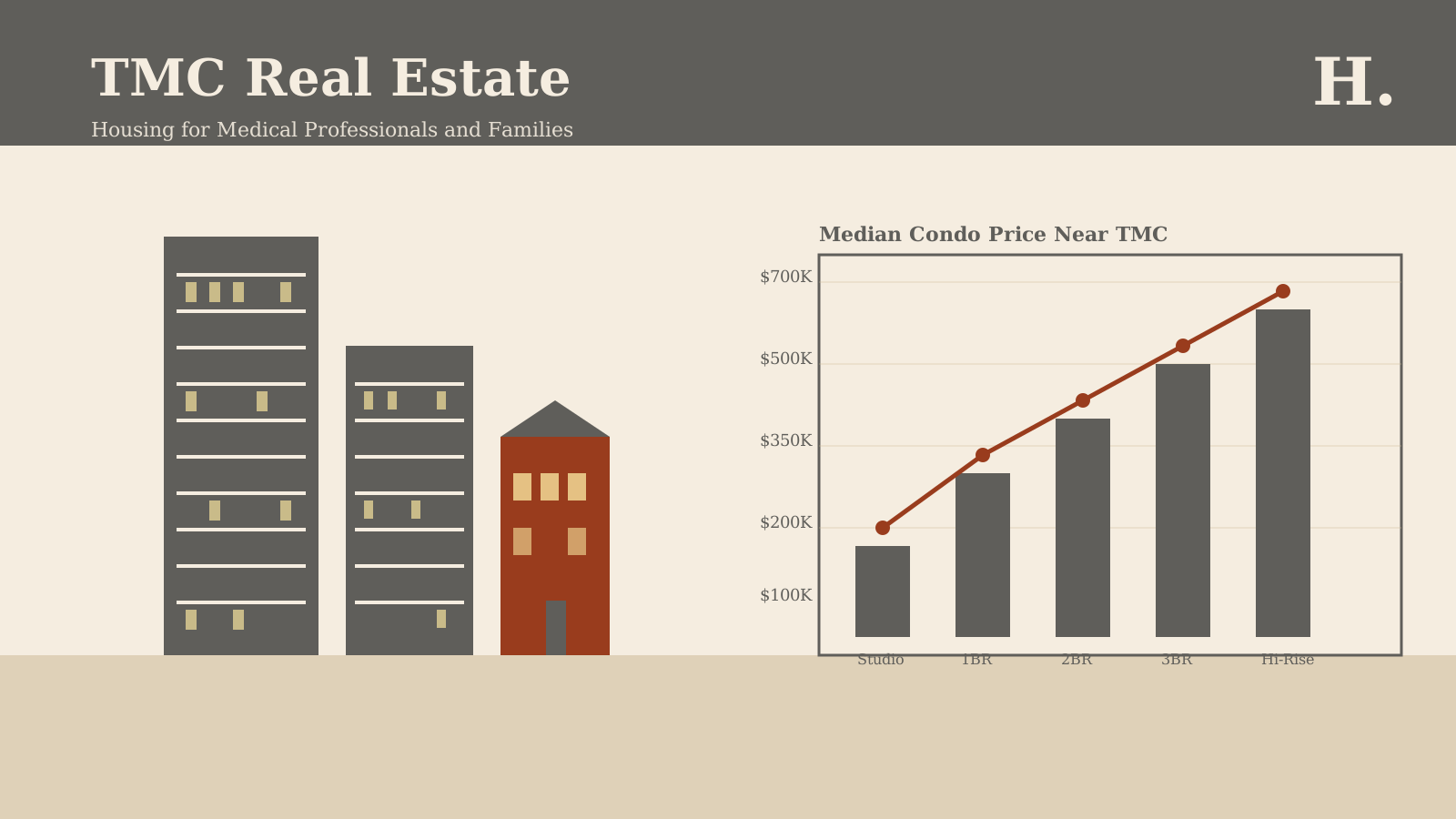
Texas Medical Center real estate in Houston: resident-physician hi-rises, Fannin corridor condos, patient-family rentals, and where to look for single-family homes near the TMC.
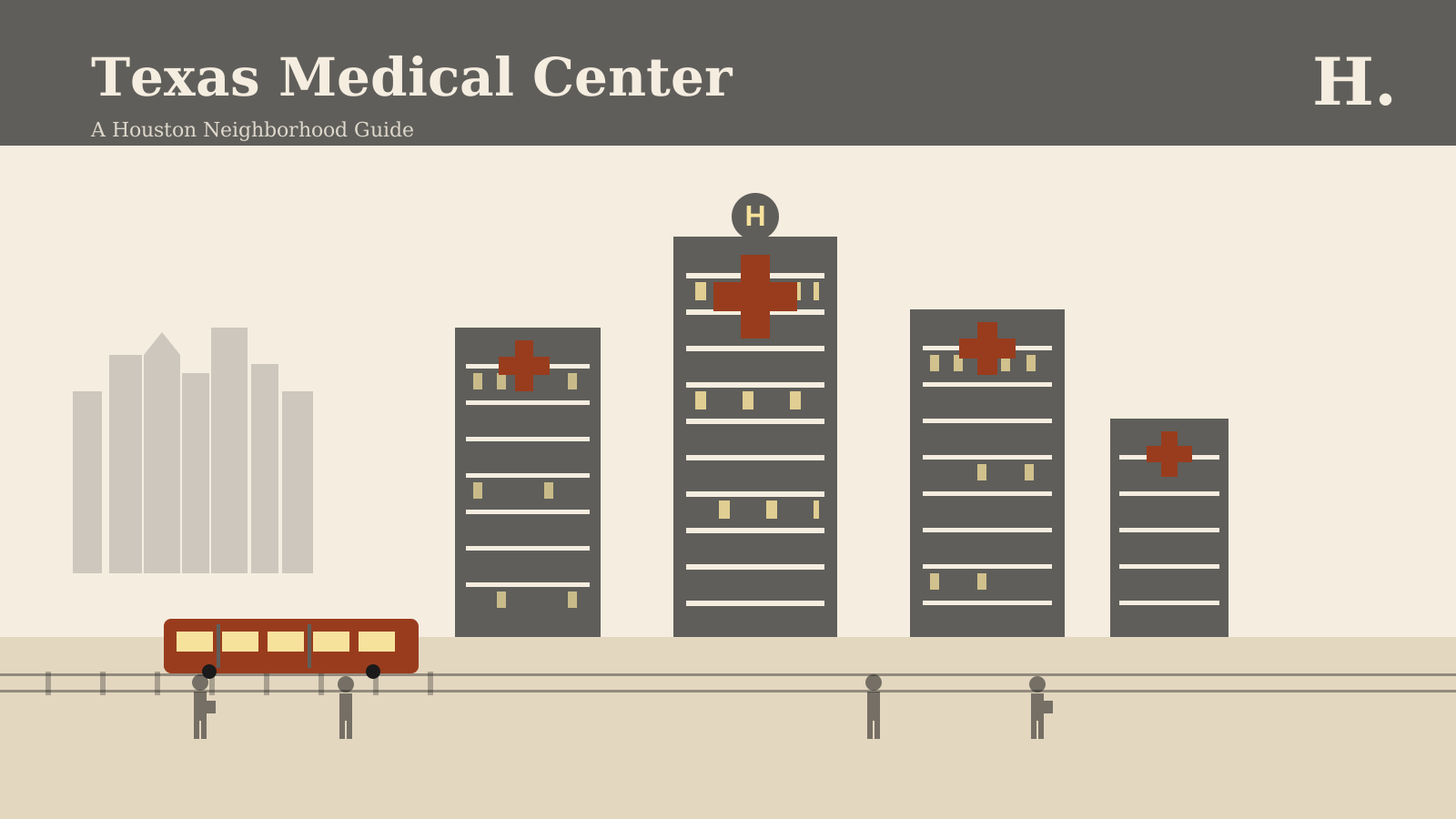
A Houston neighborhood guide to the Texas Medical Center area: the 1,345-acre TMC campus, METRORail Red Line access, hospital-adjacent housing, schools, and what life looks like here.